
Death by PowerPoint: A Step-by-Step Tutorial

Updated: May 20

Despite the groans they often elicit - and even in the age of AI - it seems slide deck presentations are not going anywhere. As highlighted by Nature's guide to scientific presentations, the classic slide deck remains the undisputed champion of science communication: universally accessible, expected at every major academic gathering, and deeply ingrained in our institutional DNA. Love them or hate them, you are going to have to use them. But wait! A captivated, alert audience means you might get difficult questions at the end from Reviewer 2, who is sitting in the front row. Why risk it? If it sounds more fun to induce a collective, room-wide coma within the first five minutes of your talk, you are in the right place! Today, we are sharing a foolproof guide to putting your peers to involuntary sleep, otherwise known as the dark art of 'Death by PowerPoint'.
A masterclass in presentation torture
To truly break the spirit of your audience, you must attack their senses! Here are the most effective ways to guarantee your research is completely ignored, or even feared.
Honour the Great Wall of Text: Never use a single word when a sprawling, jargon-filled paragraph is available. Your ultimate goal is to copy and paste your entire Methods section directly onto the slide. If your audience is frantically reading, they are not listening, which takes the pressure right off!

Font choices that cause migraines: If you must use text, ensure it is completely illegible from the third row backwards. A size 12 serif font is perfect for this. For an added layer of psychological warfare, switch between Comic Sans, Gothic and Times New Roman mid-sentence. Make it so it looks like a serial killer note cut from magazine lettering. Go wild!

Colour combinations from hell: Why use a boring dark text on a light background when you can use neon yellow text on diaper brown? Contrast is the enemy of a truly terrible presentation. If they are squinting, it just means they are working to earn and appreciate your genius.

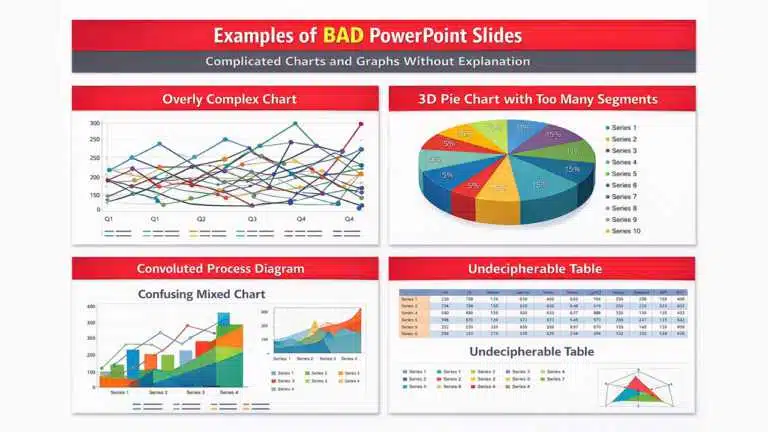
Spaghetti plots and mystery axes: When presenting your data, include every single data point you have ever collected, starting circa 2008. Overlap at least twenty lines on a single graph, ensure the legend is entirely in acronyms you invented yesterday, and make the axis labels so small they require an electron microscope to decipher. If you can understand a graph at first glance, you’ve missed the point.
Dizzying animations: Nothing says "serious academic" like a slide title that bounces in from the left like a toddler on a beach ball, accompanied by a stock laser sound effect. Apply a different, elaborate transition to every single slide and bullet point to ensure maximum motion sickness.
The robotic read-along: Turn your back to the audience and simply read your slides out loud, word for word, in a single monotone pitch, with lots of pauses for dramatic effect. Do not break eye contact with the projection screen under any circumstances. When you’re done, turn slowly and do that scary teeth-inhaling thing Hannibal Lecter does in Silence of the Lambs - straight into the mic.

Wait, you actually want people to listen?
Okay, we confess. We do actually want your research to shine too.
It is easy to fall into the trap of terrible slide design when you are pressed for time, but your potentially groundbreaking results deserve to be seen and understood. Let us then look at the antidote to presentation torture. As presentation expert Echo Rivera so brilliantly puts it:
"Your audience can either read your slides or listen to you speak. They cannot do both." (Echo Rivera)
Creating a captivating slide deck does not require a degree in graphic design. It just requires a shift in perspective. Your slides are not your script or your teleprompter. They are a visual aid designed to support your story.
Here is how you can breathe life back into your presentation:
Embrace whitespace. Give your content room to breathe. Stick to one core message or idea per slide. If a slide is getting too crowded, simply duplicate it and split the information across two screens.
Go big and bold. Use simple, sans-serif fonts like Arial, Calibri, or Helvetica. Make your body text at least size 24 (even that is small at a distance) and your headings even larger. Don’t be afraid of text in the 36 to 60 range. If someone at the very back of the hall cannot read it, it is too small.
Prioritise high contrast. Stick to high-contrast colour palettes. Dark grey or navy text on a white or light grey background is always a safe, accessible choice. We made a post before on how colour can increase accessibility.
Always design data for actual humans. Simplify your data visualisations as much as is possible without sacrificing accuracy. Highlight the specific trend or data point you are currently talking about, perhaps by greying out the less important background data. Always include clear, large axis labels.
Talk to your audience. Face the room, move around naturally, make eye contact, and use your slides simply as prompts. Your audience came to hear you speak, not to watch you read. YOU are the presentation.
Your research has the power to change the world, but only if people can understand it. By ditching the cluttered slides and focusing on clear, visual storytelling, you will keep your audience awake, engaged, and ready to ask all the right questions.
Presentation gurus to follow for more advice
If you are looking to level up your slide deck game even further, check out the work of these fantastic presentation experts:
Echo Rivera is master at helping academics and researchers turn terrible presentations into engaging, visual stories.
Garr Reynolds is the author of Presentation Zen, focusing on simplicity and storytelling in slide design.
Nancy Duarte is a communication expert who masterfully breaks down the structure of persuasive and visually stunning presentations.
Need a little extra help bringing your research to life? The team at Animate Your Science is always here to help you turn those complex findings into visual masterpieces. Take a look at our training programs. We offer a workshop dedicated to presentation skills and slide design, or you can master AI for researchers, which will make slide decks much easier to prepare.
Slide decks are here to stay. Getting them right is simpler than you think, and they can pay dividends when you get them right. Remember: less is more!


