
There is a plan to liquidate academia. Here's who wrote it.

When I started Animate Your Science in 2017, I was full of optimism. I was certain I would surf a growing global wave as science communication became more recognised and funded. For the first five years, that turned out to be true: 30% year-on-year growth, five permanent staff, a wide network of contractors, and work I was genuinely proud of. Meaningful research reaching people who would never otherwise have seen it.
Then things went sideways. Sales stalled, reserves tightened, and I had to restructure the team. We found a new point of stability (briefly). Now in 2026, a second low is hitting: sales declined again, we are losing money, and I had to make further cuts.
I started wondering: is this me? Am I making crucial mistakes leading this company, or has the ground shifted under my feet? I am certainly no perfect leader. I have my fair share of flaws and blind spots, but I think the ground is really shifting globally.
The Global Picture
Here in Australia, universities are cost-cutting left and right, struggling to attract enough international students to sustain past spending levels. For example we had multi-year partnerships with universities acquiring our portfolio of online courses. We lost two out of three: one because of a merger, one because of cost-cutting. The merger itself is a symptom of things not going great; otherwise, why merge two universities? The last government budget delivered bad news too, with a major grant scheme focused on research commercialisation getting axed AFTER researchers spent weeks writing applications. My wife was one of them, and she was devastated.
We are hearing similar news from clients in the UK and EU, where universities are also cost-cutting.
The US Proposal That Shocked Me
Then came the piece of news that really shocked me from the US. A friend from California sent me an article explaining in detail a package of laws proposed by the US Office of Management and Budget. If the rule passes in October 2026, it would mean:
Political appointees, not scientists, decide which grants get funded. Peer review becomes advisory only. A political appointee can override the scientific community's judgment with zero explanation.
Active grants can be cancelled at any time, for any reason. Mid-project. No misconduct required. Just "doesn't align with our priorities anymore."
International collaboration is severely restricted. Travel, partnerships, joint research with scientists in dozens of countries: presumptively banned or requiring political sign-off.
Publication fees are unallowable. That means federally funded scientists may not be able to publish their findings open access.
Science communication could effectively be banned for federally funded researchers. The proposed rule prohibits using federal grant funds for any public communications that could be labelled "issue advocacy." Given that the rule's own preamble classifies climate science, public health research, and DEI research as "divisive ideology," a researcher speaking publicly about their own federally funded findings on any sensitive topic puts their entire grant at risk.
Note: this is not yet law. The public comment period is open until approximately July 13, 2026. But this is what's being proposed right now for one of the most influential research ecosystems on the planet.
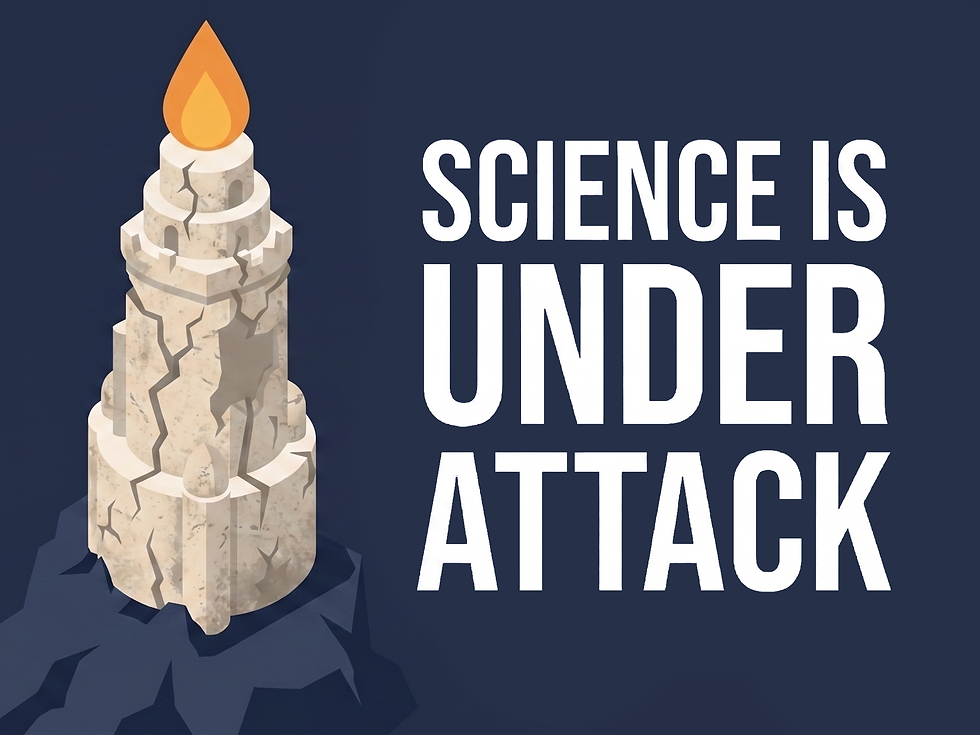
This is a full frontal attack on academia as an institution. It's much more than silencing researchers by making science communication risky for their funding stability. It is an active dismantling of the academic institution.
Connecting the Dots: The Dark Enlightenment
All of this started to make a disturbing kind of sense when I remembered something I'd come across months earlier and nearly dismissed.
A Linkedin post about a fringe political philosophy called the Dark Enlightenment. My first reaction was: this is a conspiracy theory. I read more. I wasn't so sure. I put it aside, telling myself it was too extreme to ever amount to anything real. Watching what's unfolding now, I can't do that anymore.
I started reading about a guy called Curtis Yarvin. Never heard of him before. He's a blogger and software developer who, in the mid-2000s, started writing about a political philosophy he called the Neo-Reactionary movement, or NRx. The core ideas: democracy is a failed experiment, government should be run like a corporation with a CEO at the top, and human beings are not equal. He wasn't shy about it.
The concept that stuck with me was what Yarvin calls "The Cathedral." In his framework, the Cathedral is the invisible power structure that controls what's considered acceptable thought: universities, mainstream media, and the federal bureaucracy, all working together. They manufacture consensus and then enforce it under the guise of "neutral expertise." Science, in his view, is one of the Cathedral's most powerful tools.
Yarvin wrote in 2021 that to achieve real regime change, it is "absolutely essential... that all accredited universities be both physically and economically liquidated."
I read that and had to read it again.
Here's where it gets uncomfortable. These ideas didn't stay in a niche blog. They found an audience in Silicon Valley, among people frustrated with regulation, progressive culture, and slow-moving institutions. Peter Thiel became an early investor in Yarvin's tech ventures. J.D. Vance has cited Yarvin by name, echoing in a 2021 podcast that a future administration should fire every mid-level bureaucrat and replace them with loyalists. DOGE, co-led by Elon Musk, mirrors almost exactly what Yarvin called RAGE — Retire All Government Employees — a systematic dismantling of the non-political civil service.
Through this network, these ideas reached the highest levels of the Trump administration. It is also worth noting that NRx and Project 2025 share many of the same core ideas. The dismantling of the administrative state, the concentration of executive power, and the purging of institutional expertise, which tells you something about how far these ideas have travelled from a fringe blog into mainstream conservative policy planning. So when I looked at what was happening to universities, to research funding, to science communication, it all started to look less like chaotic policy-making and more like a plan being executed.
What We Can Do
Thank you for following me down this rabbit hole. I know it sounds insane. But I believe this is what's happening. Knowing about it won't stop it on its own. They are in power, and they are moving fast. But awareness is where any response has to begin.
Here's what you can do:
1. Do your own research, then share what you find.
Don't just take my word for it. Search for Curtis Yarvin, the Dark Enlightenment, the OMB proposed rule. Read the Wikipedia article. Read Elizabeth Ginexi's breakdown. Do your research and come to your own conclusions. Then talk about it publicly. The most powerful thing right now is volume. The more people talk about this the harder it becomes to dismiss. You don't need a perfectly argued essay. A LinkedIn post saying "I just looked into the Dark Enlightenment and this is what it means for science" is enough. The absurdity of this agenda becomes self-evident once people see it.
2. Submit a public comment on the OMB rule.
If you're a US-based researcher or work with US-funded science, your voice counts here. The public comment period is open until approximately 13 July 2026. Submit your comment here.
I feel for our American colleagues who cannot escape this reality. And I am seriously concerned about the global ripple effects, because what happens to US science does not stay in the US.
I started this post talking about my business. I'll end there too. Animate Your Science exists because researchers want to communicate their work. But if researchers are silenced, defunded, or afraid to speak, there is no science to communicate. There is no industry built around it.
This is existential.


